Tracing the Astronomical Alignments at Göbeklitepe
Unveiling the Cosmic Wisdom of Ancient Builders
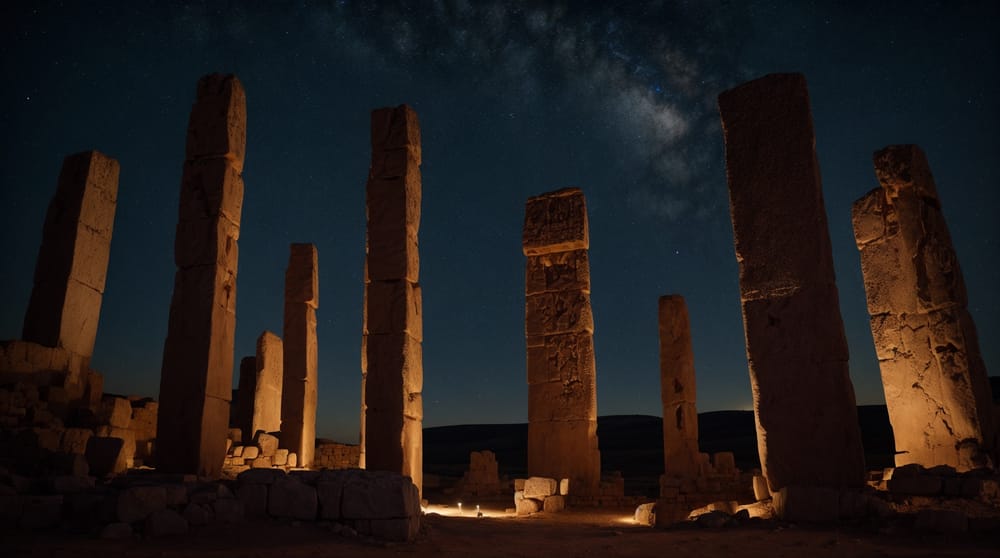
Göbeklitepe, often heralded as the world's first temple, is not only a marvel of prehistoric architecture but also a testament to the astronomical prowess of its builders. Located in modern-day Turkiye, this Neolithic site, believed to date back to the 10th millennium BC, showcases massive stone pillars intricately carved with wild animals and abstract symbols. Recent studies suggest these aren't mere decorations but part of a sophisticated system aligning with stellar constellations.

The orientation of Göbeklitepe's central pillars points towards significant celestial events, notably the solstices and equinoxes. This alignment supports theories that early Neolithic communities used astronomical knowledge not only to track time but also for ceremonial purposes, blending their understanding of the cosmos with spiritual beliefs. The site's layout suggests that observations of the sky played a role in its construction, aligning with key lunar and solar cycles.
Decoding the Stone Pillars and Their Celestial Connections
The monolithic T-shaped pillars of Göbeklitepe stand as silent witnesses to the Neolithic ingenuity. Archaeologists and astronomers collaborate to decode the meanings embedded in their carvings, which may indicate early forms of constellation mapping. For example, some carvings potentially represent constellations like those seen in later Babylonian and Greek astronomy. This suggests a continuity and possible transmission of astronomical knowledge through the ages, bridging prehistoric innovations with later ancient civilizations.

One cannot overlook the impact of Göbeklitepe's astronomical alignments on the socio-religious fabric of its time. These alignments potentially served as a powerful medium for the elite or priestly classes to consolidate power, wielding astronomical knowledge as a divine tool. The ability to predict celestial events would have appeared magical and authoritative to ordinary people, thus embedding these leaders with a mystical aura and control over communal rituals.
The Legacy of Göbeklitepe's Astronomical Practices
The legacy of Göbeklitepe goes beyond its monumental architecture and carvings. It encompasses a profound grasp of celestial mechanics, evidenced by the site's alignment with various astronomical phenomena. This profound understanding likely influenced not only religious practices but also the agricultural calendar, which would have been crucial for a fledgling agrarian society. Today, as we uncover more about this site, Göbeklitepe's role in shaping early astronomical practices continues to be a focal point of research and intrigue.