Göbeklitepe Life
Göbeklitepe Religion: Rituals, Sacrifices & Spiritual Practices
Göbeklitepe's religious significance rests on evidence for communal ritual rather than on proof of a defined faith: stone circles raised by hunter-gatherers, huge deposits of animal bone pointing to feasting and sacrifice, and human remains that hint at funerary rites. The site is best understood as a ceremonial gathering place. Calling it a temple, in the sense of a building with a settled priesthood and doctrine, goes beyond what the excavation has produced.
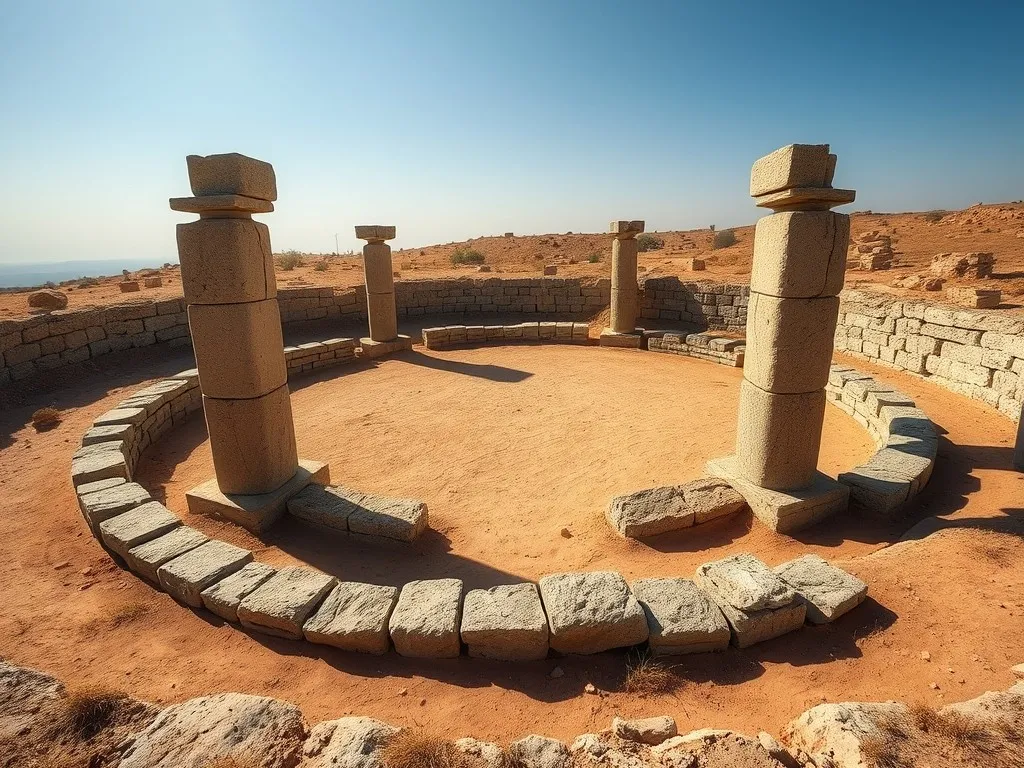
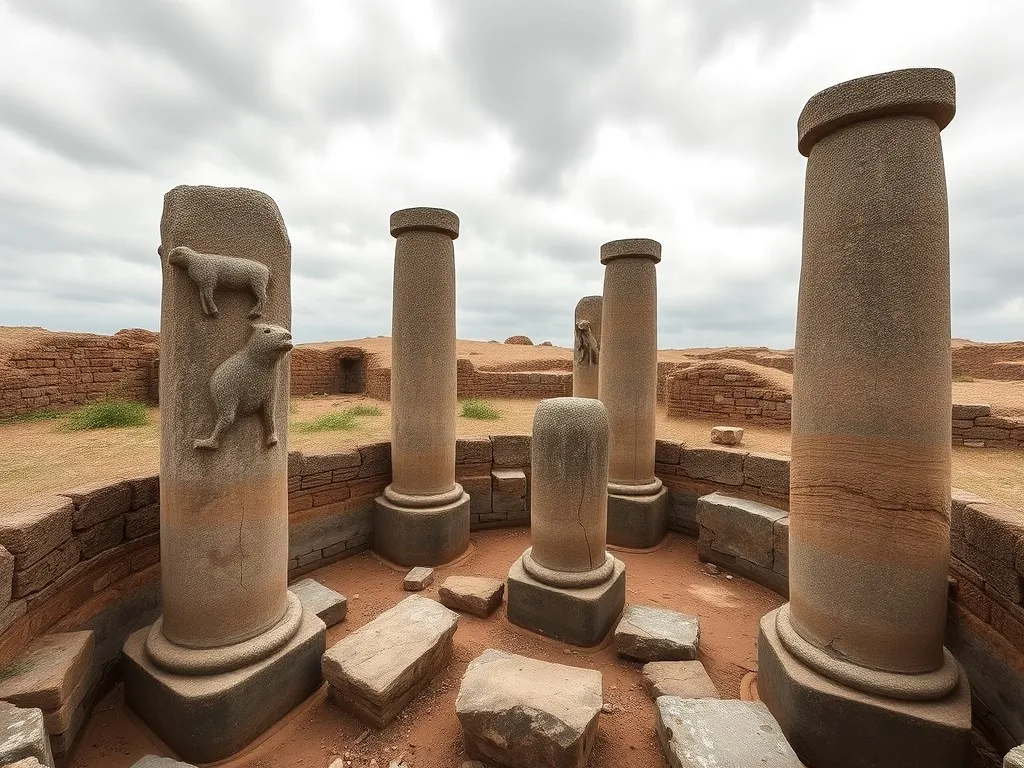
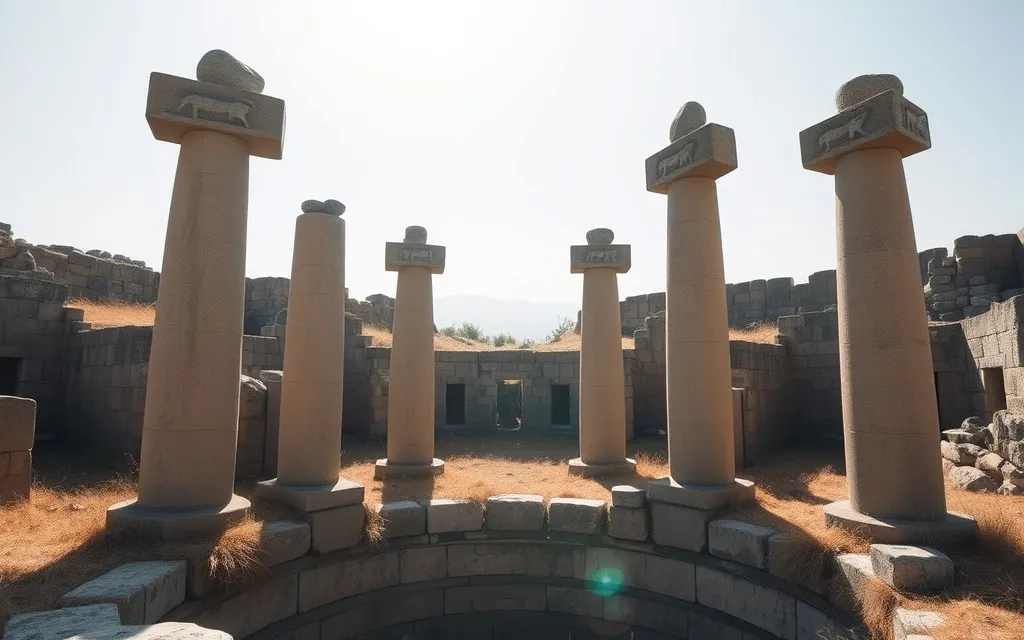
The architecture itself is the strongest evidence, and it is repetitive. Each circular enclosure holds 10 to 12 massive stone pillars arranged around two larger monoliths set in the middle. That same layout recurs across the enclosures, which points to a shared ritual grammar rather than a single one-off construction.
The scale of the work tells you the effort was collective and planned. The T-shaped pillars are carved from limestone, and some stand over 18 feet tall and weigh up to 50 tons. Moving and raising them required coordinated labour by people who were not yet farmers.
The setting matters as much as the stones. The large circular structures were carved directly into the bedrock below ground level. Anyone taking part entered a sunken, enclosed space rather than approaching a free-standing shrine, so the ritual was something you went down into, not something you walked up to.
Feasting, Sacrifice and the Animal Bones at Göbeklitepe
The most concrete evidence for repeated ceremony at Göbeklitepe is not carved stone but bone. Excavations have uncovered tens of thousands of animal bones, showing that many species were slaughtered, sacrificed and presumably eaten at the site. That is a material record of bodies brought in, killed and consumed, not of prayers recited in an empty enclosure.
The quantity is what matters. A single household could not have eaten its way through such a deposit, and the mix of wild species points to animals driven in from the surrounding landscape rather than herds kept on site. The scale implies gatherings of many people, fed together on repeated occasions. Whether you read the circles as shrines or as meeting places, the bones show that people came in numbers and ate.
Feasting is a well-documented way early communities built alliances and marked important occasions, and the animal bone fits that pattern without requiring a formal priesthood. Someone had to organise the hunt, the butchery and the distribution, but organising a feast is not the same as ordaining a clergy. The carved pillars and their reliefs may have framed these occasions, though how the meat and the stone related is still an open question.
What the bones cannot tell you is the meaning attached to the killing. Sacrifice and ordinary provisioning leave similar traces, and distinguishing one from the other depends on context that is often missing. The safe claim is narrower than the popular one: large communal meals with a ceremonial dimension took place here, repeatedly, over a long span.
Human Remains and the Question of Funerary Ritual
Human bone has come out of the ground at Göbekli Tepe, and that single fact has been stretched into a large claim: that the hill was a Neolithic burial ground where the dead were laid to rest and funerary rites performed. The bones are real. The interpretation is an inference, and a modest one at that.
Some researchers have gone further and proposed excarnation, the deliberate removal of flesh from bone before or instead of burial. It is a reasonable hypothesis for a Neolithic context, but it rests on the condition and distribution of the fragments rather than on any reconstructed rite. No text, no grave goods arranged in a readable pattern, no clearly furnished tomb explains what was done with the bodies.
The proportions matter more than the headlines. Compared with the animal bone recovered from the enclosures, the human material is scarce, which argues against burial being the site's sole or even principal purpose. The honest reading is that human bones were also found at Göbekli Tepe, and that funerary activity was one strand among several at a place used for many things.
Burial at Göbekli Tepe is attested; a cemetery is not.
Pilgrimage and the Absence of a Town
The excavated area has yielded no houses, granaries, streets or midden heaps spreading out from the walls. No village remains have been found at or near the ruins, which is the main reason excavators read the site as a ceremonial centre rather than a settlement. Local hunter-gatherer groups are the presumed users, people who came, built, feasted and left.
How far they came is a separate question, and a harder one. Figures of up to 200 kilometres are cited as an argument that Göbeklitepe drew pilgrims, and the reasoning is straightforward: if the people building and using the enclosures were not living beside them, they were travelling, and travel to a fixed sacred place is pilgrimage by another name. That reading fits the scale of the enclosures and the effort locked into their construction, and it has shaped how the site is presented since Klaus Schmidt's first seasons on the hill.
It is still an inference, and two inferences stacked on each other. The absence of a village is evidence of absence only within the area excavated, and the 200-kilometre figure is a reconstruction of catchment, not a measured journey. Pilgrimage is plausible, perhaps likely, but it is not established by the stones themselves.
Where the 'World's First Temple' Label Came From
The label has an author. Excavations at Göbekli Tepe were led by Klaus Schmidt, whose team began digging in the 1990s, and it was Schmidt who argued that the enclosures were built for ritual rather than domestic use. He drew that conclusion from the absence of domestic refuse and hearths at the site, reading the enclosures as a ceremonial center rather than a settlement. That is a hypothesis about how the place functioned, offered by the person who knew the stratigraphy best.
The phrase itself came from a magazine. In 2006, the German news weekly Der Spiegel ran a cover story that advanced Schmidt's description of Göbeklitepe as the "world's first temple." Cover lines need compression, and "a large communal ritual complex of the early Neolithic, function still debated" does not fit on a newsstand. The shorthand travelled further than the argument behind it.
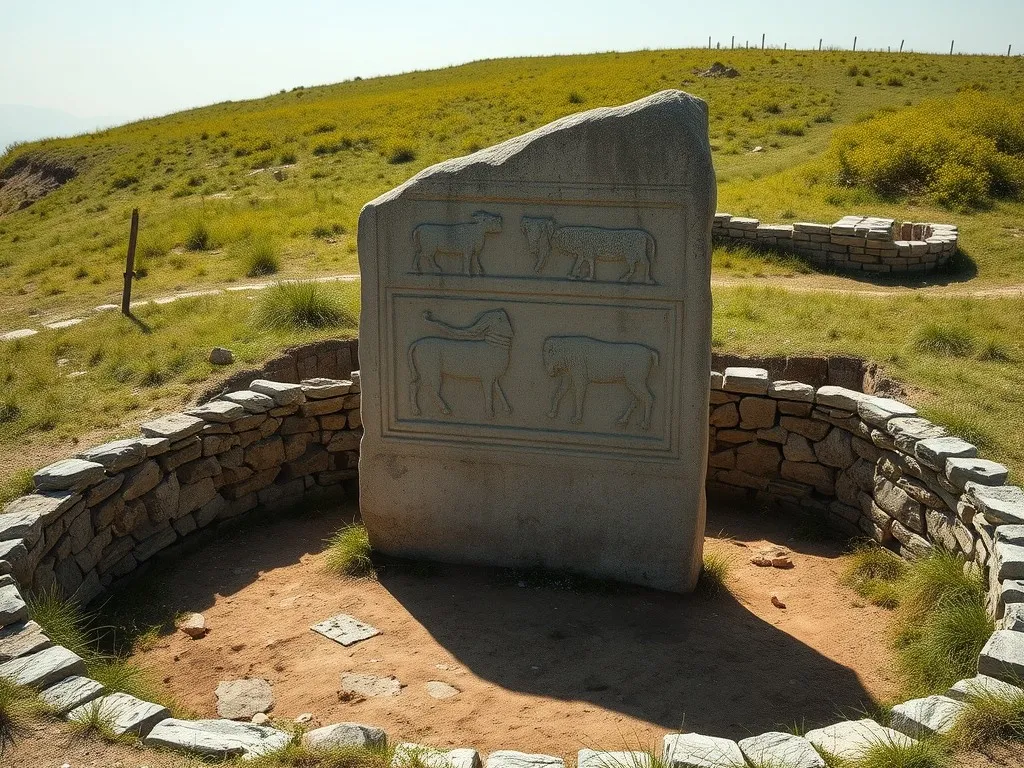
Read the phrase for what it is: a journalist's summary of one archaeologist's interpretation, not a finding recorded in the ground. Nothing in the excavation report declares a temple; the T-shaped pillars, the animal reliefs and the absence of hearths and refuse support a special-purpose reading, and that is all. Later work has moved toward multifunctional assembly places, where ritual, feasting and exchange overlapped rather than separating into a single category we would call religion.
The useful question is not whether the slogan is true, but what would count as evidence for or against it. Anyone repeating the phrase should be able to say who coined it, in what year, and on what basis.
What the Religion Probably Was, and What It Probably Was Not
Put the material evidence together and a modest picture emerges. People came to this hilltop in the centuries between roughly 10,000 and 8000 B.C.E., raised heavy T-shaped pillars into circular enclosures, carved animals and human figures onto them, feasted on game, and left animal bones behind. Some of their dead were buried there too. That pattern fits periodic gathering — seasonal or otherwise — with shared meals, animal sacrifice, deposition of remains and a symbolic world in which animals and human figures carried real weight.
What the evidence does not support is a single codified faith. Nothing at the site indicates a written doctrine, a professional priesthood, or a temple in the later Mesopotamian sense of a god's house with a resident deity and an organised cult. Those are models imported from societies thousands of years later, and the stones here neither confirm nor require them.
The site predates writing, so every account of belief is inference from what was built, killed, eaten and buried. That limitation applies to the sober reconstructions as much as to the slogans. The honest verdict is a ritual tradition — repeated, formal, communal practice — rather than a religion with doctrine, scripture or clergy. When the enclosures were eventually filled in, the practice around them changed too, a shift examined in the theories on why Göbeklitepe was buried.
Read any claim about Göbeklitepe's religion against that standard. Ask what object, bone or building the claim rests on, and whether the same evidence could support a simpler explanation. Where it cannot, the claim is interpretation, not finding.
How New Survey Work Could Change the Picture
The picture is not settled. A survey reported in 2025, using georadar, geomagnetic and lidar methods across previously unexplored parts of the Göbeklitepe mound, identified numerous structures interpreted as possible dwellings. That single result cuts at the heart of the conventional reading, because a hill used only for ritual and a hill where people also slept and cooked are two very different places.
If those structures really are houses, the sharp split between a purely sacred enclosure and a secular settlement begins to weaken. The carved pillars and the animal bones would then sit inside a lived landscape rather than a remote sanctuary, and the ritual reading has to be reframed around people who were present every day, not visitors who came and left. The survey data alone cannot decide this; only excavation of the new areas will, and that work has barely begun.
Göbeklitepe was added to the UNESCO World Heritage list in 2018, which matters for how fast the story can change. Listed sites draw international scrutiny of both digging and conservation, and interpretations made in the field are published, argued over and revised rather than quietly dropped. That scrutiny is exactly what will test the new survey work: as geophysics is checked against the ground, the religious significance of the site is likely to keep shifting.
Frequently Asked Questions
Did Göbeklitepe have a god or gods, and can we know their names?
No names of gods survive from Göbeklitepe, and no written texts exist from the site to preserve them. The carvings of animals and human figures on the pillars suggest a symbolic world tied to hunts, animals and possibly ancestors rather than named deities. Any claim about specific gods at the site is interpretation, not evidence.
Were the T-shaped pillars themselves objects of worship?
The pillars were probably not worshipped as gods but served as monumental settings for ritual, with the central pair framing the focus of each enclosure. Their anthropomorphic form suggests they stood for beings or ancestors rather than idols. Their scale and carving point to ceremony, not simple idolatry.
Why did the builders bury the enclosures if the site was sacred?
The enclosures were deliberately backfilled, and the reason remains debated rather than settled. Burial may have closed a structure after its use, protected it, or formed part of a renewal cycle, since the circles were carved into the bedrock below ground level. No text explains the practice, so any explanation stays a hypothesis.
Is Göbeklitepe older than agriculture, and does that change its religious meaning?
Göbeklitepe predates farming in the region, dating between roughly 10,000 and 8000 B.C.E., and that timing reshapes its religious meaning. Because no village remains have been found, the site is read as a ceremonial center built by local hunter-gatherer groups rather than by settled farmers. Ritual, not agriculture, may have driven the gathering.
For the full overview, see spiritual history of göbekli tepe.
Related in this series: gobeklitepe artifacts, gobeklitepe discovery story.