The Akkadian Empire fell to a drought so severe it erased their cities and we are heading for the same climate trap right now
The silent killer behind the first empire's fall
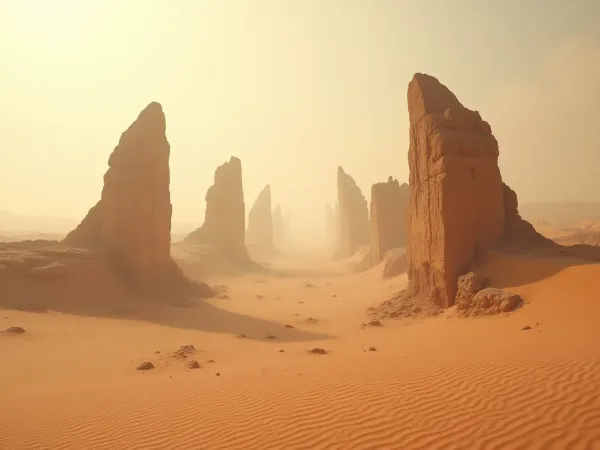
Most people think empires die from war. Wrong. The Akkadian Empire — the world's first true state — crumbled because its rivers dried up and its crops withered.
This isn't just a dusty history lesson. It's a mirror held up to our modern world. We're building economies on finite resources and ignoring the same environmental signals that destroyed Sumer.
Why the usual story about Rome and Maya is missing a key point
We love the dramatic tales of invading armies. But look at the data from the Maya lowlands between and CE. Warfare was real, yes. Yet the primary driver was a prolonged drought that stripped their agricultural base.
The Roman Empire fell to a mix of pressures. Political instability played a role. But the sheer cost of defending borders while managing shrinking trade routes was fatal. It was economic and logistical strangulation, not just a military defeat.
I find it frustrating how often we simplify these events. We label them 'bad leadership' or 'barbarian invasion.' That's a lazy narrative, and it hides the deeper systemic failures.
The Akkadian case study and what the clay tablets reveal
Around BCE, the Tigris and Euphrates rivers began to shift. Rainfall in northern Mesopotamia dropped sharply. The agricultural heartland of the empire started to fail.
Clay tablets from that era speak of famine and unrest. The centralized government could not feed its people. Loyalty evaporated as fast as the water sources.
Here's where it gets scary for us. The Akkadians had centralized power and sophisticated agriculture. They were the 'advanced' society of their time. Yet they could not adapt to a slow environmental change.
How this connects to the engineering gap we ignore in early history
We often skip over the pre-farming ingenuity of early humans. We assume they were simple and passive. The evidence says otherwise. They built complex structures before they even had stable food supplies.
If you're interested in how early humans planned their environments before agriculture took over, consider reading about new cave finds that prove engineering came first. It changes the whole narrative.
Modern parallels we are currently ignoring at our peril
Look at Easter Island. For decades, it was the go-to example of a society killing itself with deforestation. Newer research complicates this. Disease and outside violence played huge roles too.
But the core lesson remains. Resource depletion creates a fragile society. When you strip away your buffer, any external shock becomes fatal. We're seeing this in modern supply chains and water tables.
The economic trap of relying on finite energy sources
Rome relied on slave labor and endless expansion. This discouraged innovation in sustainable agriculture or efficient energy use. We see a similar pattern today with our reliance on fossil fuels.
We spend trillions on defense and infrastructure that locks us into high-carbon paths. This is the same kind of rigid commitment to status quo that doomed the Akkadian administration.
Inequality worsens this. When the elite hoard resources while the general population struggles to feed themselves, social cohesion breaks down. This is exactly what happened in late Roman society.
What we can learn from the survivors of ancient collapses
Here's a hopeful twist. The Maya did not disappear. Their descendants are still here. The Ancestral Puebloans migrated and adapted. Collapse was often just a painful transition, not an extinction event.
This suggests that our modern crisis might also be a period of painful restructuring. But only if we choose to adapt rather than double down on the failing model.
The role of political will in preventing disaster
We know what needs to be done. Reduce emissions. Level inequality. Invest in renewable resources. The technology exists. What's missing is the collective will to prioritize long-term survival over short-term profit.
This isn't a call for doomsday. It's a call for clarity. We have the unique advantage of seeing where others fell. We can choose to step back from the cliff edge.
If you want to understand how early humans managed their environments before modern politics got involved, take a look at why ancient sites were built before farming. It provides context for human ingenuity.
Conclusion and the path forward for our generation
The past is not a prediction. It's a set of data points. The Akkadians had less information than we do today. Yet they still fell into the same trap.
We have more tools. We have better science. But do we have the wisdom to use them? The answer will define whether our civilization adapts or collapses.
I believe we can do better. But it requires us to look at the evidence without bias and act on what we see. The clock is ticking for everyone.
For more on how ancient discoveries challenge our current understanding of progress, explore how museum artifacts prove history is incomplete. The truth is often stranger than the textbooks.