The Berlin Exhibition Reveals How Göbeklitepe Challenges Humanity’s Long-Held Beliefs
Göbeklitepe's Secrets Challenge the Foundations of Human History
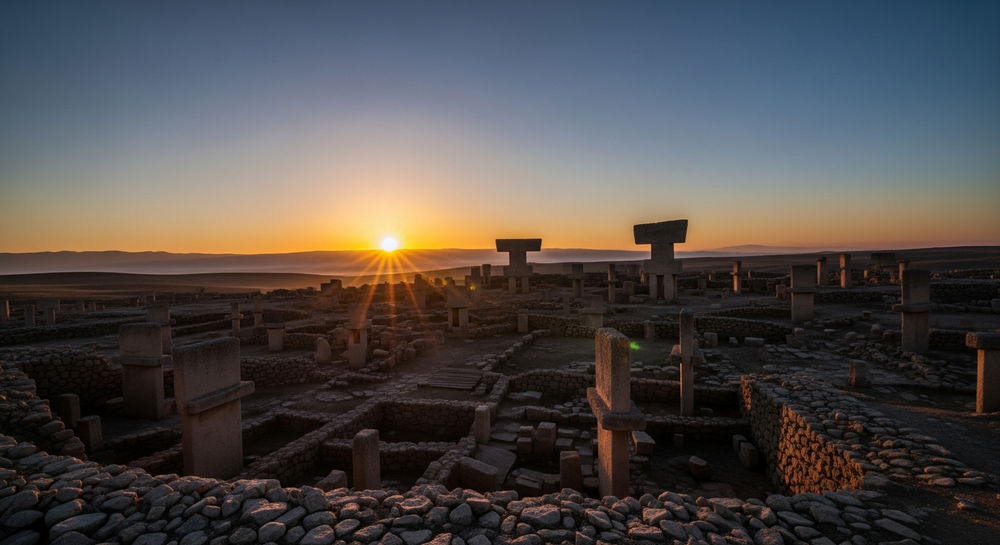
As visitors wander through the Berlin exhibition featuring Göbeklitepe’s remarkable artifacts, a striking realization emerges: our understanding of early human societies may be fundamentally incomplete. While the display focuses on the tools, carvings, and pillars that suggest complex social and spiritual practices, what is truly revolutionary is how this site complicates the narrative that humans slowly evolved from simple hunter-gatherers into settled agricultural societies. Instead, Göbeklitepe points to a civilization that might have had a sophisticated spiritual and communal consciousness long before the advent of farming and permanent settlements. This raises the possibility that human spiritual life and social complexity may have been interconnected much earlier than previously thought, forcing scholars to reconsider the very timeline of civilization. The implications are vast, suggesting that the origins of organized religion and communal identity might not be a late development but rather a foundational aspect of human existence, embedded in the earliest phases of cultural evolution. The exhibition’s curated artifacts, some displayed for the first time outside Türkiye, serve as tangible proof that humanity’s journey was far more intricate and spiritually driven than the textbook version many have come to accept.

Why This Exhibition May Only Be the Tip of the Iceberg
What often goes unnoticed in discussions surrounding Göbeklitepe's artifacts is that the site and its ongoing excavations are part of a larger puzzle that might redefine our entire view of early human ingenuity. Current research indicates that Göbeklitepe was not an isolated phenomenon but part of an expansive cultural landscape stretching across what is now southeastern Turkey. The recent cooperation between Turkish and German scholars—highlighted in the exhibition—underscores this point. This collaboration hints at a civilization far more interconnected and technologically advanced than assumed, perhaps predating agriculture by millennia. The archaeological breakthroughs at these sites have the potential to challenge the prevalent assumption that the Neolithic revolution was the dawn of civilization. Instead, it hints that early humans may have developed complex spiritual and social systems during a time they were thought to be primitive. If these findings hold, then much of what we accept as human progress might need to be rewritten, emphasizing mental and spiritual development over technological innovation alone.

The Real Winners and Losers in the Cultural Rift
As the global academic community grapples with these revelations, the question of who truly benefits from the increased focus on Göbeklitepe becomes central. For Türkiye, this exhibition bolsters national pride and elevates the country’s archaeological prominence on the world stage, potentially boosting tourism and international recognition. But for other nations, especially those claiming similar ancient sites, the narrative shift could be less favorable—challenging existing academic hierarchies and cultural claims. Interestingly, the broader consequence might be a more nuanced understanding that diminishes the dominance of Western archaeological narratives, opening space for a democratization of ancient history that appreciates cross-cultural contributions to early human civilization. Moreover, as museums in Europe and around the world seek to expand their narratives of human origin, there is a risk of oversimplification or sensationalism that could distort the deeper, more meaningful implications of Göbeklitepe’s discoveries. Ultimately, the true winners are the collective human curiosity which now demands a more honest, interconnected account of our ancient past.