The underground city that proves we built before we farmed
The hole that broke the timeline
We get told one neat story about human progress. First we hunt and gather. Then somebody invents the wheel. Finally, we build cities. A clean line on a graph.
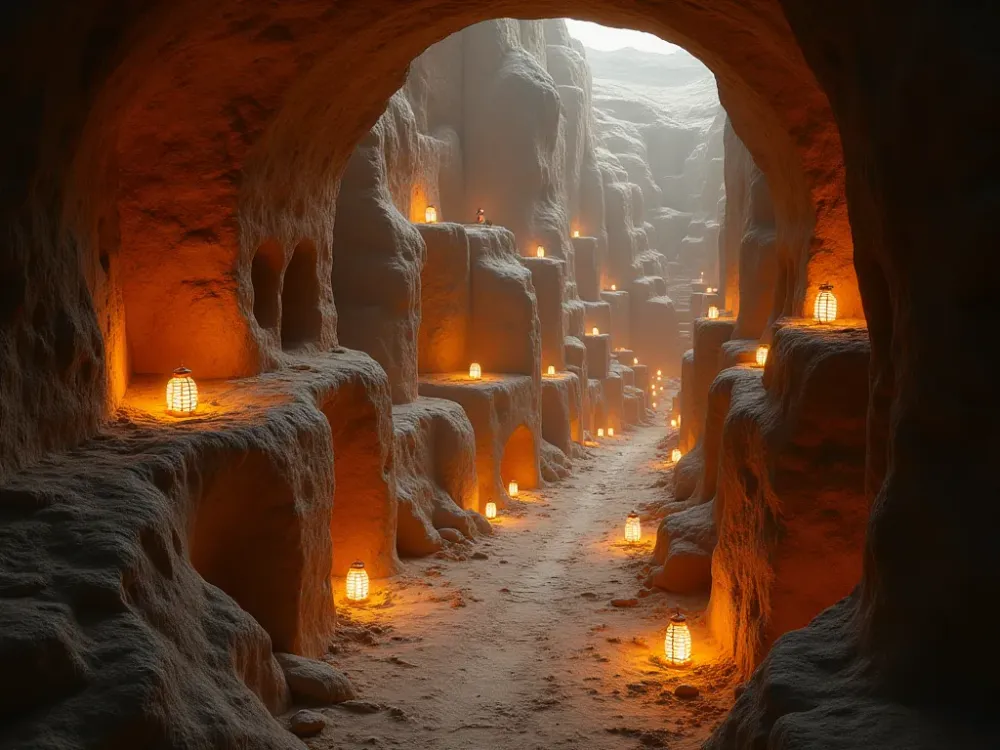
Then you look at Derinkuyu. An underground city in Turkey, eighty-five meters below the surface. It has streets. It has ventilation shafts.
It predates the pyramids by millennia. And it challenges the whole idea that you need farming before you can build anything complex.
Why the timeline feels wrong
The standard model goes like this: agriculture created surplus. Surplus allowed specialization. Specialization led to engineering.
But Derinkuyu hints the reverse might be true. Maybe complex social structures came first, and they're what let us survive harsh conditions.
So there's a gap in our understanding. Where does the planning come from?
The cognitive leap we missed
Building a multi-level city takes abstract thinking. You have to visualize space that doesn't exist yet.
That cognitive ability shows up in the record long before written history. A silent revolution.
We need to stop picturing early humans as simple. They were engineers of their environment.
The tunnel systems that defied gravity and time
And Derinkuyu isn't alone. Other subterranean marvels are scattered across the globe.
Each one tells a story of survival. They were built for defense and storage.
Engineering without modern tools
How did they do it? Stone hammers and copper tools. The precision is astonishing.
The ventilation systems are the part that gets me. Air flows through narrow shafts.
That shows a deep understanding of physics. Not magic — calculation.
The weight of stone and water
They also had to manage groundwater. A single leak could collapse the structure.
The drainage channels were carved with extreme care. That required specialized labor.
Which implies a division of labor we rarely associate with pre-agricultural societies.
The connection to Göbeklitepe and the mind of the builder
To understand these tunnels, you have to look at the surface. Göbeklitepe is the other half of this puzzle.
It's a site of ritual. It predates pottery and metal tools.
Why religion might have come first
Most scholars believe religion is a byproduct of complexity. Göbeklitepe suggests otherwise.
Here, belief drove construction. People gathered to worship before they settled down.
That flips the script entirely. The spiritual impulse may have been the engine of history.
The shared cognitive architecture
Building a temple and digging a city are different tasks. But they require the same mental map.
You have to think three dimensions deep. You have to anticipate the future needs of a group.
That cognitive capacity was present ten thousand years ago. Older than we assumed.
What this means for how we teach the past
Our textbooks are linear. Simple to complex, in a straight line.
Reality is messy. It jumps and overlaps.
The gap in the curriculum
Students learn about Rome and Egypt. They rarely hear of the people who came before.
Which creates a false sense of sudden invention. It hides the gradual evolution.
We need to include these sites in standard narratives. They are the foundation.
Rethinking the definition of civilization
Civilization isn't just cities. It's the ability to organize complex labor.
By that metric, our ancestors were civilized long before the first brick was laid.
This changes how we see ourselves. We're not new to this. It's an old habit.
The final lesson from the stone and the dark
These sites are not just ruins. They are evidence of a different kind of human.
They were capable. They were organized. They believed in something larger than themselves.
When you stand before these structures, the timeline blurs. The past is closer than we think.
A call to look deeper
Don't accept the simple story. Dig deeper.
The truth is in the details. In the ventilation shafts and the stone circles.
History is not a straight line. It's a web of connections and capabilities.
And that changes everything we think we know about who we are.