Göbeklitepe's Hidden Secret Could Rewrite Humanity's Spiritual Origins
The Unexpected Depths of a 12,000-Year-Old Human Representation
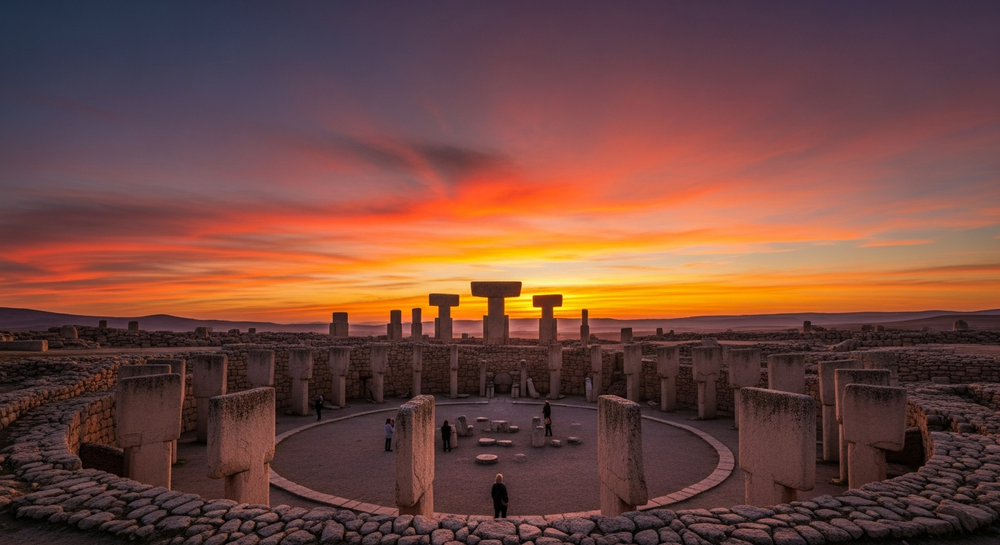
Few archaeological finds have stirred universal fascination quite like the recent uncovering of a human-shaped statue embedded directly within the wall of Göbeklitepe’s chamber. While many have celebrated the site's monumental pillars and animal carvings for their impressive craftsmanship, this new discovery hints at a deeply symbolic and ritualistic dimension that has yet to be fully appreciated. The statue's careful placement suggests it was more than mere decoration; it was probably an offering or a sacred effigy, perhaps representing a deity or ancestor, carved with the intent of connecting the living community with the spiritual realm. This challenges long-held assumptions that early humans mainly interacted with their environment through utilitarian survival or basic spiritual symbols. Instead, it indicates a complex belief system where figures played a central role—possibly as mediators between humans and the divine. Given the site's age, over 12,000 years old, this pushes the boundaries of what we consider the origins of religious consciousness, transforming Göbeklitepe from merely an architectural wonder to possibly the earliest known expression of human spirituality. This shift in understanding could redefine the narrative, positioning ritual practices as the catalysts for societal development rather than just agricultural or settlement needs, a perspective that significantly complicates the traditional timeline of civilization's evolution.
A Paradigm Shift in Understanding Early Civilizations
Historically, scholars have viewed the rise of complex societies as driven primarily by agriculture and resource management. Monuments like Stonehenge or the Egyptian pyramids have reinforced the idea that monumental construction was a product of technological progress and centralized power. However, Göbeklitepe’s recent findings suggest a revolutionary alternative: that spiritual and ritual practices may have come first, shaping societal structures from the ground up. The presence of this embedded human statue, along with the site's rich carvings and symmetrical layout, indicates that early humans invested significant effort in crafting symbolic representations, perhaps as part of belief systems that unified groups around shared mythologies. If early humans used ritual to forge social cohesion and abstract notions of existence, then religion or spirituality was likely a primary driver of community organization—preceding and possibly initiating the development of agriculture itself. This reinterpretation forces us to confront whether our linear understanding of civilization—dependent on technological milestones—is overly simplistic. Instead, it suggests a more intricate dance between spiritual motives and societal complexity, with Göbeklitepe acting as a keystone that potentially rewrites history’s chronological assumptions.

The Controversy and Its Broader Implications
This discovery doesn’t just add a new artifact to the list of ancient relics; it has the potential to upend longstanding academic perspectives and ignite debates across multiple disciplines—from archaeology to religious studies. Skeptics caution against overinterpreting these sculptures and placements, warning that we should avoid projecting modern spiritual concepts onto ancient artifacts. Nonetheless, the consistency of the find—carefully embedded figures within the structure—implies deliberate intent, not accidental deposition. If verified, this could mean we are witnessing the earliest proof of ritualistic or animistic practices that predate the emergence of settled farming communities. Such a realization would make Göbeklitepe not just an archaeological site but a vital key to understanding the *beginning* of human consciousness and spiritual awareness. It also raises questions about who these early artisans were—were they shamanic figures, spiritual leaders, or community elders whose influence extended beyond survival into shaping cosmological narratives? In a sense, this find may imply that humanity’s deepest beliefs originated long before civilization as we have traditionally defined it, positioning Göbeklitepe as a crucial chapter in our shared origins that we are only beginning to comprehend.